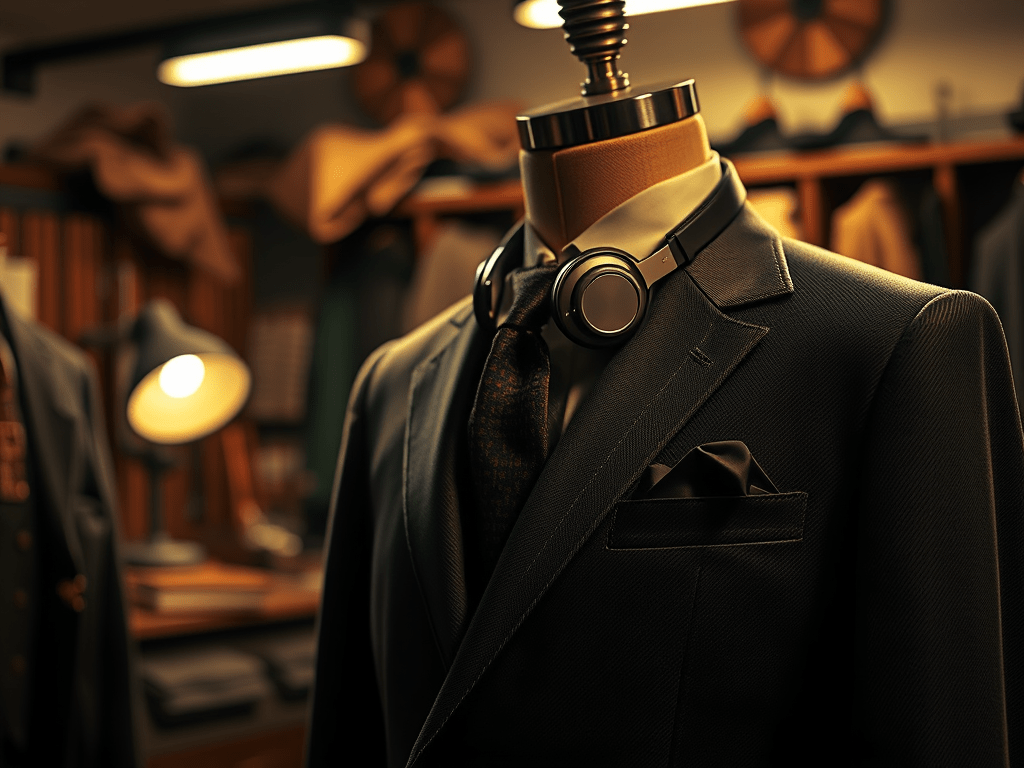
I remember the first time I bought a proper suit for work. When I say ‘proper suit’ I mean one that was actually adjusted by a tailor to fit me personally. Let’s be clear – this was no Armani, but by my humble standards it felt pretty special. Standing in the store while the tailor fussed around with pins and muttered to himself about sleeves and seams, I felt very grown-up. The suit may or may not have been made from scratch for me but it was being made to fit me specifically.
That is what “bespoke” used to mean. A rare kind of luxury. Something reserved for those with the means and access, for the privileged and wealthy. If you are a fan of the popular Netflix series, ‘Bridgerton’, you will know exactly what I mean. Tailored clothing, private tutors, commissioned art – bespoke was a word you used when talking about someone with money and taste, or at least someone who knew a tailor.
It seems like now everything is bespoke.
Bespoke playlists.
Bespoke vitamins.
Bespoke financial advice.
Bespoke meals, diet plans, skin care routines and meditation apps.
Your newsfeed is bespoke. Your advertisements are bespoke. Your Streaming services offer bespoke entertainment suggestions, and your Social Media feeds are curated ‘just for you’.
Every aspect of our life can now supposedly be individually tailored and curated.
And it is slowly destroying us.
When Everything Fits Me, Nothing Challenges Me
Let’s be honest: there is a lot to love about our personalised worlds. They’re convenient, efficient and comforting. We’ve built entire ecosystems to ensure that we never have to experience anything outside our personal preferences if we don’t want to.
But somehow in this flood of hyper-personalisation, we’ve lost something. A few things, actually:
- We’ve lost resilience.
Our threshold for discomfort has dropped. When life gets too loud, we cancel the noise. When opinions clash with ours, we mute them. When content doesn’t immediately gratify, we scroll past. - We’ve lost connection.
Tailoring everything to our own preferences narrows the range of people we naturally interact with. It’s hard to build community when each of us is walking through life with our own soundtrack, newsfeed, filter, and belief buffet. - We’ve lost curiosity.
Or maybe we’ve just smothered it under a thick layer of algorithms and aversion to surprise. When you can skip the journey and teleport straight to your destination, why risk getting lost? Why explore?
We often say, “It’s about the journey, not the destination,” but then we do everything we can to avoid the journey.
Noise-Cancelling Headphones and the Spectrum of Noise
Take noise, for example. Or rather, the absence of it.
We live in an overstimulated world, and in response, we’ve wrapped ourselves in layers of soundproofing. Noise-cancelling headphones have become a staple accessory, not just for public transport or shared offices, but for everyday life. They filter out the hum of humanity, the dull roar of living, the sensory overload of the modern world. Surely that is a good thing, right?
And when it’s not silence that we want, we can choose from an array of noise types to fill it. Anyone old enough to remember analogue television knows about white noise – that static sound you got when switching between channels or when the signal dropped out. Well, now we don’t just talk about ‘white noise’. Today, we also have the likes of pink noise, brown noise, blue noise, violet noise and grey noise. (For the curious: white noise is all frequencies at equal intensity – think TV static. Pink noise reduces higher frequencies, sounding more like steady rainfall. Brown noise is deeper, rumbling like distant thunder. Grey noise adjusts for human hearing sensitivity. And yes, beige noise is apparently a thing too – like noise that’s been through HR and asked not to upset anyone.)[1]
The point isn’t whether the noise is present or absent – the point is that we’re in control of it.
Recent reports highlight how young adults are increasingly overwhelmed by public spaces and face-to-face interactions, turning instead to ASMR videos – gentle tapping, whispered words, the digital equivalent of a sensory hug. It is now common to see people walking outside wearing their noise-cancelling headphones and watching videos online with subtitles, despite perfectly hearing the sound. One YouGov survey showed that 61% of 18–24 year-olds prefer to watch TV with the subtitles on. I have seen this at play in my own home, where our 15-year-old prefers to have subtitles on for everything he watches.
You would think that having so much control over what we listen to would be a good thing. And to be fair, it can be. As BBC health reporter Hannah Karpel notes:
“Noise-cancelling headphones do have their benefits, particularly for long-term ear health where their soundproofing feature can prevent high frequency and loud noise from reaching and damaging the ear – even while listening to music.”
So far, so good. Who doesn’t want their eardrums to remain intact?
But not all is well in the kingdom of curated calm. Claire Benton, vice-president of the British Academy of Audiology, offers a more sobering take:
“By blocking everyday sounds such as cars beeping, there is a possibility the brain can ‘forget’ to filter out the noise.”
In other words, the brain starts getting a little too comfortable in its bespoke acoustic bubble. And like most of us after a holiday, it forgets how to function in the real world.
Benton continues:
“You have almost created this false environment by wearing those headphones – only listening to what you want to listen to. You are not having to work at it.”
Which, of course, sounds eerily like most of our digital lives.
She goes on to explain that this false environment may have lasting consequences – especially for younger users:
“Those more complex, high-level listening skills in your brain only really finish developing towards your late teens. So, if you have only been wearing noise-cancelling headphones and been in this false world during your late teens, then you are slightly delaying your ability to process speech and noise.”
In short: your brain, like any muscle, needs a bit of a workout. And if we keep outsourcing all our filtering to clever technology, we may find ourselves struggling to handle even the basic background hum of real life.[2]
In addition to these concerns, Hyperacusis – a condition marked by heightened sensitivity to normal environmental sounds – is on the rise among children and adolescents. Studies suggest it affects nearly 20% of teens.
We’re not coping with silence. And we’re not coping with noise. What we seem to want is sovereignty over both.
The Illusion of Limitless Choice
The bespoke trend goes beyond our audio world. We are constantly bombarded with stimulus of all kinds – the physical avalanche of sensory input and the relentless assault on our cognitive and emotional faculties. It is no wonder that we want to try and protect ourselves in some way. But when protection becomes isolation, and curation becomes avoidance, we’re in trouble.
We now have the tools to choose everything – what we hear, what we see, what we eat, what we believe. Choice is a modern virtue. But it comes with its own shadow.
- Option paralysis.
- Decision fatigue.
- The slow erosion of surprise.
The more we tailor the world to our own preferences, the less we have to reckon with the reality of other people’s experiences. We select our news sources. We align our algorithms (or they are determined for us). We decorate our echo chambers. And then we wonder why society feels so fractured.
This impacts our communities. It impacts our sports clubs, our churches, and our schools. When everything becomes personalised, shared experience becomes harder to find. We struggle to grieve together, to rejoice together, to wrestle together – because the things that once united us have now been streamed into custom playlists, curated feeds, and niche subcultures.
Friends Expand Your Vision. Algorithms Reinforce It
One of the most telling lines I’ve read recently came from an article about Spotify. Writing for The Age, Jenna Price quotes Tim Kelley – a former music executive and program director at the Australian Institute of Music:
“Spotify doubles down on our taste,” says Tim Kelley, a former music executive, quoted in The Age. “It will suggest something very similar to what you’ve already heard.”
“But when we get suggestions from our friends,” he adds, “there’s a different process. Friends try to expand your vision rather than double down on your vision.”[3]
That’s the crux of the problem. The technology that surrounds us is designed to affirm us, not stretch us. To say, “Yes, more of the same,” rather than “Have you ever considered this?”
When a friend recommends music, a book, or a film, they’re not usually trying to mirror your existing tastes. They’re saying, “I know you. But I also know something you might love, even if it’s new, strange, or a little outside your comfort zone.”
That’s a profoundly human gift. It’s one that no algorithm is likely to replicate.
We Used to Eat Seasonally
Here’s another curious shift. Once upon a time, if you wanted strawberries, you had to wait for strawberry season. Same with tomatoes, or apricots, or asparagus. It was a lesson in patience, and in enjoying things in their proper time.
Now we can have whatever we want, whenever we want. Global food distribution, refrigerated freight, and advanced agriculture mean seasonal fruit and vegetables are available year-round – picked early, ripened artificially, shipped across hemispheres. Convenient, yes. But something gets lost in the process.
And it’s not just about food. It’s about how we’ve come to expect everything – information, entertainment, experiences – to be available on demand. No waiting. No wondering. No growing into something over time. And no accidental discoveries along the way.
Antifragile
This shift – from seasonal limitation to year-round availability – isn’t just about food. It’s part of a broader cultural impulse to avoid delay, difficulty, and even discomfort. Which brings us to the idea of being antifragile.
Psychologist Jonathan Haidt, in his work on social trends and mental health, has explored this concept through the lens of antifragility. I’ve referred to his work in other pieces I have written. Building on Nassim Nicholas Taleb’s original idea, Haidt argues that some things – like the human psyche – aren’t just resilient; they’re antifragile. They grow stronger through stress, not despite it.
We are not just harmed by hardship – we are also harmed by its absence. When everything is tailored to keep us safe and comfortable, we don’t just miss out on growth. We may actually start to weaken.
Haidt writes,
“Children are antifragile. If we overprotect them, we harm them.”
The same might be said of our social, emotional, and spiritual selves. A little exposure to discomfort, to unfamiliar ideas, to challenge, can help us build the kind of depth and strength that no algorithm can replicate.
And it seems the same might be true in more realms of life than we first realised. Go back to our noise problem. Audiologists say it is important to hear a diversity of sounds so the brain can decide what is important to focus on. By blocking everyday sounds such as cars beeping, there is a possibility the brain can “forget” to filter out the noise. Our brains need to be challenged, to work at filtering noise, or they may forget how to. In my more cynical moments I am tempted to refer to ‘resilience-cancelling’ rather than ‘noise-cancelling’ headphones!
Not All Bespoke Is Bad
Let me be clear: not all bespoke experiences are bad. In fact, some of the best involve handing the reins to someone else entirely.
There’s a restaurant near us that offers a “chef’s special” menu. You tell them your dietary needs, maybe a preference or two, and then you let go. You don’t choose what you’re getting. The chef, guided by the availability of local produce and their creative skill, does the rest. It’s a bespoke meal, but it’s also an act of trust. It’s risky. But in my experience, it’s nearly always worth it. I’ve eaten things I never would have selected from a menu – ingredients I’d normally avoid – and found myself enjoying flavours I didn’t even know I liked.
That kind of curated experience doesn’t narrow my world – it expands it. But it only works because I hand over control. And I can’t help but wonder if the fact that I am handing over control to another human, rather than an algorithm, is important.
Maybe that’s the kind of bespoke we need more of. Not one where we retreat into comfort, but one where we open ourselves to surprise. Where we say, “Here’s who I am, and here’s what I need,” and then trust people – the community, the church, the world, even God – to bring something to the table we didn’t see coming.
Bespoke Belief?
Even in our churches and spiritual lives, we risk drifting toward hyper-customisation. Much has been written, most of it critical, about the concept of Moral Therapeutic Deism (MTD) – a phrase coined by sociologists Christian Smith and Melissa Lundquist Denton in Soul Searching: The Religious and Spiritual Lives of American Teenagers. Of the five key points that define MTD, this one is most relevant here:
“The central goal of life is to be happy and to feel good about oneself.”
This assumption has crept its way into many Christian communities without us even realising. We pick and choose spiritual practices that serve our needs – often for their secondary mental health benefits – while forgetting that ancient disciplines like silence, fasting, and sabbath weren’t designed for self-optimization. They were invitations to be reoriented. Not curated comfort but chosen discomfort with purpose.
Now in the interests of transparency, I should confess that I am not a big fan of every spiritual tradition. In particular, fasting is something that does not serve me well. The only ‘reorientation’ I experience when fasting is a rapid shift from a vertical to a horizontal position. Apparently, I don’t have particularly spiritual blood-sugar levels. Leaving that aside, it may be instructive to consider, in whatever church tradition you find yourself, what practices are being shaped by our desire to personalise and customise every aspect of our lives in ways that may be harming us more than benefiting us. Consider the songs we sing, the style of sermon we like to hear, the length of our services… Even communion has not escaped the bespoke revolution – once a simple, shared act of unity – it can sometimes resemble a hospitality station at a conference: gluten-free here, grape juice there, individual cups neatly spaced beside the common chalice. These choices are born of care and inclusion, but they also reflect how even our most sacred communal moments can become subtly shaped by the culture of personal preference.
So Where Do We Go From Here?
I’m not suggesting we throw away our headphones or delete our Spotify accounts. But maybe we could make some small choices – simple acts of defiance against the curated comforts of modern life.
- Listen to a whole album, start to finish, even the weird tracks you’d normally skip.
- Reset your Social Media algorithm – or ignore its recommendations for a week.
- Ride the train without headphones and just… be present.
- Let a friend choose the film.
- Read an article from a publication you usually avoid – not to argue, but to understand.
- Try something unfamiliar, even if it makes you a little uncomfortable.
It’s not about being dangerous. Just different.
Just enough to remind yourself that the world is wider than your preferences.
So, here’s the question I leave you with:
When was the last time something unfamiliar changed your mind – or your heart?
What might happen if we stopped tailoring the world to fit us, and instead let the world shape us a little?
Leave your bespoke thoughts and experiences in the comments. I’d love to know what you think – when is personalisation good or bad?
[1] https://www.bettersleep.com/blog/a-complete-guide-to-colored-noise-exploring-the-sound-spectrum-in-colors
[2] Are noise-cancelling headphones to blame for young people’s hearing problems? BBC, 16 February 2025 https://bbc.com/news/articles/cgkjvr7x5x6o
[3] It’s not just musicians who starve with Spotify. Turns out we all do, The Age, March 6 2025 https://www.theage.com.au/culture/music/it-s-not-just-musicians-who-starve-with-spotify-turns-out-we-all-do-20250302-p5lg7h.html


 The Lowe-Down
Leave a comment