
When was the last time you asked someone, “Did you see the news?” and they immediately knew what you were referring to? Probably not recently. The way we consume news has changed dramatically, and depending on your age, your social media habits, and even your interests, your version of ‘the news’ might look completely different from mine.
With news coming from countless sources – many of them online and increasingly filtered by social media algorithms – the stories we encounter are highly personalized. The result? The news I see may be completely different from what my 22-year-old neighbour sees, and different again from the stories a 15-year-old encounters.
Where Are Young People Getting Their News?
Recent studies show a significant shift toward social media as a primary news source for young people. That’s not surprising. What caught my attention was that despite the rise of digital sources, family remains the most trusted news source for kids aged 8-16. In an age of personalized news feeds, that’s an encouraging reminder that real conversations still matter.
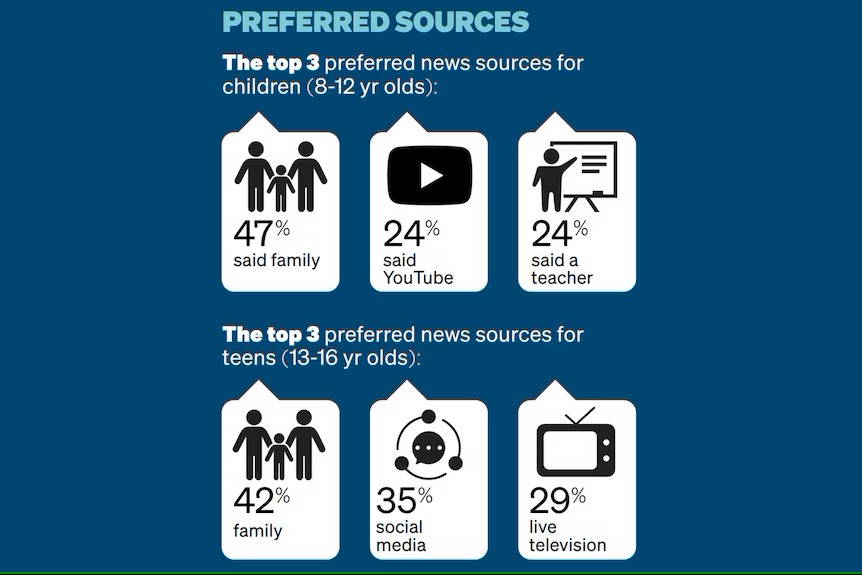
Preferred news sources of children and teenagers. (News and Young Australians in 2023, CC BY-NC-SA)
I’ll admit it – I’m an old-school news consumer. I still get the paper delivered on weekends and generally rely on the digital versions of mainstream news publications for my current affairs updates. So, when younger people I knew started referencing TikTok as a news source, my instinct was to push back – how could anything good come from a platform better known for dance trends and meme culture?
But after some discussion (and a fair bit of persistence on their part), I decided to try out some of these sources for myself. With guidance from my own kids (most of my social media accounts were originally set up just to monitor their activity – a largely failed attempt, but that’s a story for another time), I began exploring news updates from creators like Dylan Page, who claims to have the largest English-language news account on TikTok with 14.6 million followers.
To my surprise, I found that while I still had concerns about fact-checking, some of the better social media news sources made a genuine effort to verify information and even corrected errors when they were identified. Of course, a single social media influencer doesn’t have access to the same research resources as a journalist from a major news organization. But that raises a larger point: no one source should be relied upon entirely. Comparing multiple perspectives is essential for anyone engaging critically with news media.
What About Bias?
Bias was another concern I had. Interestingly, I found that the biases of social media influencers were often more obvious and easier to identify than the subtler, deeply ingrained biases of larger media outlets. Bias is unavoidable, but being aware of it equips us to question it thoughtfully.
And speaking of bias – I had to admit that Dylan Page’s delivery was far more engaging than I was expecting and more interesting than many formulaic TV news reports. Not every creator’s style appealed to me, but I could see why young people might prefer short-form video content over lengthy articles or traditional news broadcasts. While I’m not fully converted, I am willing to eat a slice of humble pie and admit there might be something to it.
What Does This Mean for All of Us?
The way we consume news has changed, and it’s not just young people who need to navigate this landscape. Whether you’re a parent, a teacher, or simply someone trying to keep up with the evolving media world, here are a few takeaways:
- Teaching critical thinking skills is as important as ever.
- We should apply those same critical thinking skills to our own media habits, not just to what younger generations consume.
- We shouldn’t assume that young people are disinterested in news and current affairs – they may simply be engaging with it in different ways.
- Regular discussions about news and current events can equip all of us to engage critically and intelligently. These conversations can happen around the dinner table, during commutes, or over coffee.
Finally, we don’t engage with news and current affairs in a vacuum. Our values and beliefs shape how we interpret and respond to the world around us. Naturally, we want to instil thoughtful engagement in younger generations, and discussing daily news can be a great way to do that. For Christians, the Apostle Paul’s words to the church in Rome offer a pertinent reminder:
“Don’t become so well-adjusted to your culture that you fit into it without even thinking. Instead, fix your attention on God. You’ll be changed from the inside out. Readily recognize what he wants from you, and quickly respond to it. Unlike the culture around you, always dragging you down to its level of immaturity, God brings the best out of you, develops well-formed maturity in you.” (Romans 12:2, The Message)
Or, as theologian Karl Barth famously put it:
“Take your Bible and take your newspaper, and read both. But interpret newspapers from your Bible.” (Time Magazine, May 1, 1966)
So, the next time someone tells you, “I saw this on TikTok,” resist the eye-roll. Instead, ask questions, dig deeper, and model the kind of critical thinking we all need in this endless flood of information. After all, in the words of Jerry Seinfeld, “It’s amazing that the amount of news that happens in the world every day always just exactly fits the newspaper.”





 The Lowe-Down
Leave a comment