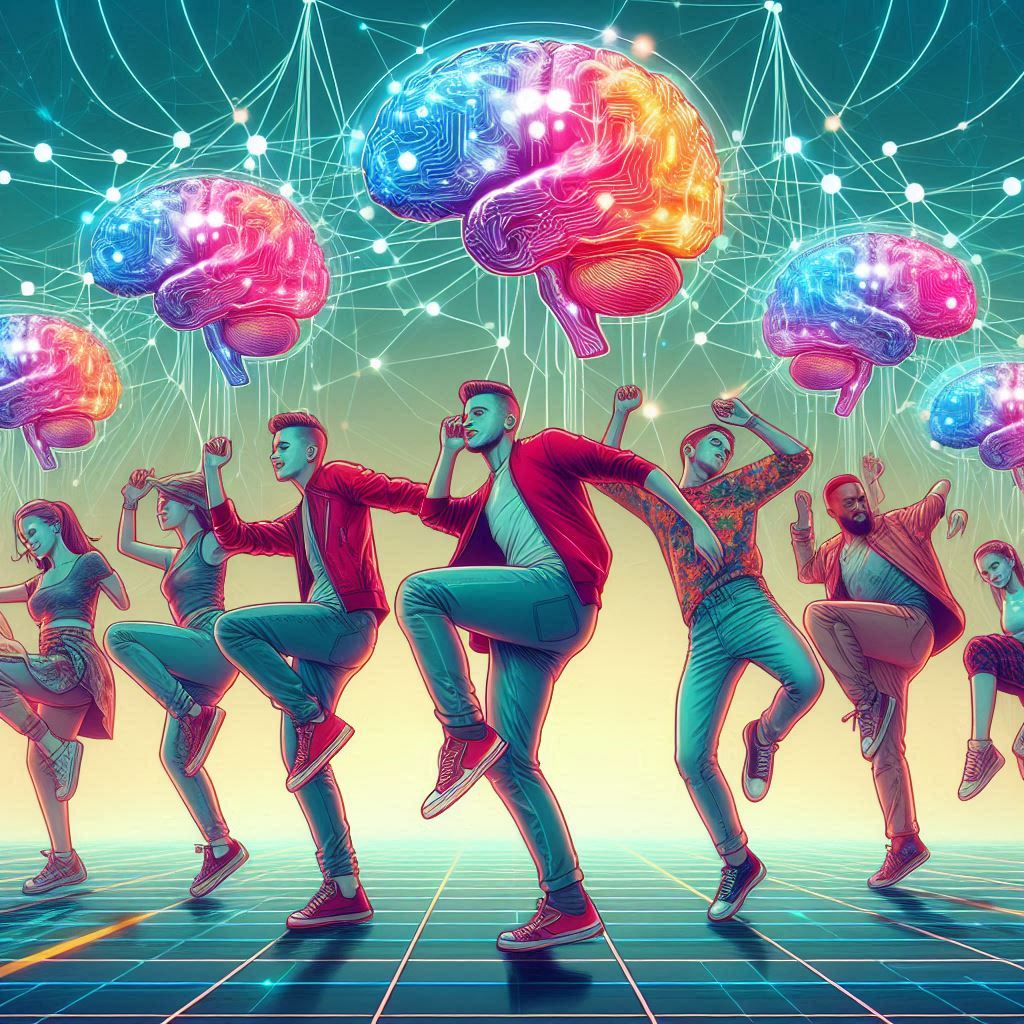
I am not much of a dancer, and I generally don’t enjoy dancing because it makes me feel incredibly self-conscious and embarrassed. That said, I wish I could dance, or at least find the self-confidence to attempt it despite my ineptitude. I’ve seen some very impressive individual dancing at school events over the years, but it is those moments when everyone joins in with the same dance moves that really stand out for me. Whether it is to the Nutbush or the Grease Megamix, there is something remarkable about watching a group of people move in unison to the beat of a song.
I may not be a dancer, but I am a drummer and I do take great delight in that feeling of locking into a rhythm and playing in perfect sync with it. Even better if I am surrounded by other musicians who are locked into the same beat. I have noticed over the years that we seem to be getting worse at staying in time together. This is purely anecdotal – I have no solid research to support the claim – but listening to large groups of students clapping along to songs in School chapels and assemblies, I am sure they find it harder now to clap in time with each other and to the music than the students of ten or twenty years ago. If I am right (and I may not be), I can’t help but wonder why that might be and whether it matters beyond the unsettling of my musical sensibilities.
Enter the concept of synchrony.
What is synchrony? To quote award winning science journalist, Lydia Denworth, “When we find ourselves nodding at the same time as our conversation partner or smiling together when we watch a funny movie, that’s synchrony. When we clap our hands in unison with others during a concert or while happily playing with our child, that’s synchrony.”
That is what synchrony looks like but what is actually going on inside our brains when this happens and why is it important? Denworth goes on to explain it this way:
“Collective neuroscience, as some practitioners call it, is a rapidly growing field of research. An early, consistent finding is that when people converse or share an experience, their brain waves synchronize. Neurons in corresponding locations of the different brains fire at the same time, creating matching patterns, like dancers moving together. Auditory and visual areas respond to shape, sound and movement in similar ways, whereas higher-order brain areas seem to behave similarly during more challenging tasks such as making meaning out of something seen or heard. The experience of “being on the same wavelength” as another person is real, and it is visible in the activity of the brain… Without synchrony and the deeper forms of connection that lie beyond it, we may be at greater risk for mental instability and poor physical health. With synchrony and other levels of neural interaction, humans teach and learn, forge friendships and romances, and cooperate and converse. We are driven to connect, and synchrony is one way our brains help us do it.”
https://www.scientificamerican.com/article/brain-waves-synchronize-when-people-interact/
I love it when science and faith reach the same conclusion about something. Our human drive to connect makes perfect sense from a Christian view of humanity which understands people as relational beings made in the image of a relational God. So, from both a scientific and a theological perspective, relationships are important, and communication is an integral part of relationships. How we communicate shapes the way we relate to each other. And this is where synchrony and modern communication methods collide.
Social Psychologist, Jonathan Haidt, whom I have quoted in previous articles, has a lot to say about the impact of mobile phones and social media as a primary means of communication for young people. Jon Schaff gives a helpful summary of Haidt’s concerns in a recent blog post:
“Why does the omnipresence of such portable technology matter, especially for mental health? We must make a distinction between the “real world” and “virtual world.” The real world, says Haidt, is embodied, consisting of experiences that are synchronous (happening right now) and having some level of intimacy. They also “take place within communities that have a high bar for entry and exit,” giving people incentive to invest in the relationship, and forgiving and repairing relationships when they hit rough spots.
By contrast, the virtual world is disembodied. If fact, some participants might be AI. It is asynchronous, as communication is typically through posts and comments. Also, communication is “one-to-many,” meaning it is directed towards a mass of people with whom we lack any actual personal relationship. Finally, virtual communities are unstable in that relationships are easily entered into and easily broken.
The lack of intimate embodied human relationships contributes toward poor mental health. The nature of the online world tends to draw young people within themselves, neglecting real world experiences they need to develop into emotionally healthy, responsible individuals, while simultaneously addicting them to the very virtual world that contributes to their anxiety and depression.”
Does this mean all electronic communication is bad? Of course not! Asynchronous communication (the opposite to synchronous) can be very useful for many things but what it won’t do is build relational connections in the same way that synchronous communication does. Perhaps this goes a long way towards explaining why millennials and Gen Z are often described as simultaneously the most connected and the loneliest of generations.
The challenge, of course, is trying to explain this to your 11-year-old who is desperately begging for access to Instagram or Snapchat or TikTok. Neither a science lesson on synchrony nor a theology lecture on the relational nature of God will carry much weight against the social pressure of peers. One thing schools can do is to provide opportunities for students to experience synchronous communication. Which brings me back to clapping out of time in assembly.
Chapels, assemblies, year-level assemblies and other group gatherings are a regular part of life at the school I work in. These events serve a range of purposes but one which is not always obvious is the opportunity they provide to connect with each other in an embodied and synchronous way – in other words, to foster the developmental growth that synchronous experiences promote. Encouraging students to sing together, to clap in time, to laugh together at a witty joke or to share a moment of silent awe after a powerful performance, these are the things that help our students form connections in ways their Insta feeds never will.
The writer of Hebrews was obviously not thinking about social media when they penned these words, but they carry a fresh weight of truth in this modern era:
“We should think about each other to see how we can encourage each other to show love and do good works. We must not quit meeting together, as some are doing. No, we need to keep on encouraging each other.” (Hebrews 10:24-25 ERV)
May you experience the mysterious joy of synchrony with each other and with the God who made himself known to us in embodied form in the person of Jesus.




 The Lowe-Down
Leave a comment