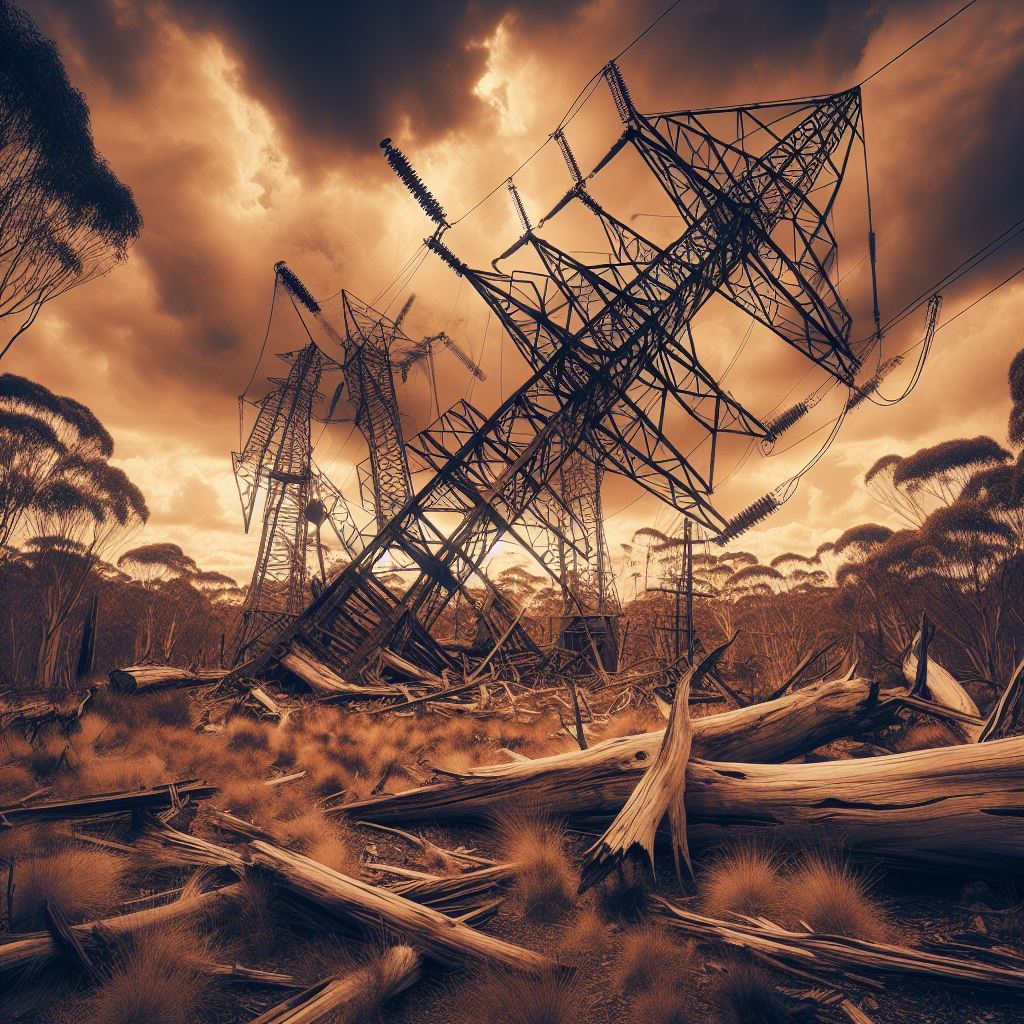
If you are reading this post, then I will take it as an encouraging sign that you have access to both power and internet after recent storms. The catastrophic weather event that swept across our State, rendering us powerless in more ways than one, prompted for me some reflection on our relationship with nature and our place in the grand tapestry of creation.
In the blink of an eye, the forces of nature dismantled our illusions of control. The widespread loss of power, internet, and phone services in the space of 20 minutes served as a stark reminder of our vulnerability in the face of the majestic power inherent in God’s creation. It’s humbling to acknowledge that, despite our technological advancements and societal progress, there are elements beyond our mastery. Not that we always appreciate the experience.
In times of crisis, our immediate response is often to seek someone or something to blame. Power companies and governments become easy targets for our frustration, as if they should have been impervious to the whims of nature. While there may be validity in holding entities accountable for preparation and response, it’s also important to maintain perspective.
The spectrum of reactions to this event that I heard highlights a broader truth about human nature. Some among us, heavily reliant on essential services for life-saving reasons, rightfully fear the prospect of prolonged power outages. However, hearing others complain about inconveniences such as the inability to place online bets or stream favorite shows suggests a lack of perspective and a disconnect from the real challenges faced by others. For some of our young people, this lack of perspective may be born simply out of a lack of life experience and offers a perfect opportunity for valuable conversation with them, to be critical but to help prepare them for future challenges that may impact them more significantly.
I can’t help but be reminded of the biblical story of Job, who, in the face of immense suffering, received this response from God:
“Where were you when I made the earth? If you are so smart, answer me. And who decided how big the earth should be? Who measured it with a measuring line? What is the earth resting on? Who put the first stone in its place.” (Job 38:4-6).
Just as Job was reminded of the vastness and unpredictability of creation, we too must recognize our place within the intricate design of the universe. The recent events were not just a test of our patience but an opportunity for reflection. In the wake of catastrophe comes the opportunity for profound lessons in humility and hope.
I don’t intend to diminish the genuine suffering and loss experienced by many in our community. The devastation to property, stock, and the heartbreaking loss of a farmer’s life in the storm demands our acknowledgment and compassion. These are real losses that cannot be overlooked or understated.
But for those fortunate enough to have emerged from this event relatively unscathed, the crumpled telegraph towers may serve as a visual reminder. They stand not only as symbols of physical damage but also as reminders of the power inherent in creation and the greater power of the Creator. A Creator whom we often imagine in very sanitized ways when life is comfortable.
An article written by Nicholas Russell, Chaplain at Christ Church Grammar School in Perth, reminded me of this reality: “Our students often conceive of God in finite terms. God is a kind ethereal man with a beard in the sky who made the world, sets up a game of life, experiences moods and his existence in much the way we do, and is subject to and dependent upon the laws of reality in the same way we are.” (https://www.aplaceformission.org/what-even-is-god/)
A God like that is easy to ignore, or sideline as irrelevant to our daily lives. But when our lives are interrupted by something like a powerful weather event, we might be prompted to look for a more robust envisioning of God. In his article, Russell draws on the work of David Bentley Hart for a different description of God.
“Hart points out that the God of Christianity, Judaism, Islam and even Hinduism (Brahman), share a common conviction – that God is the ground by which all things exist. God is the One by which all things live and move and have their being (Acts 17:28). God is the non-contingent reality that makes all contingent reality possible. God, he says, does not even exist in the sense that we do, he is instead the wellspring of all things.”
Now if this is all a bit too esoteric for you then perhaps the words of C.S. Lewis will resonate more. In the story of The Lion, The Witch and The Wardrobe, four children find themselves in a magical world preparing for the return of the great King Aslan.
“Aslan is a lion- the Lion, the great Lion.” “Ooh” said Susan. “I’d thought he was a man. Is he-quite safe? I shall feel rather nervous about meeting a lion”…”Safe?” said Mr Beaver …”Who said anything about safe? ‘Course he isn’t safe. But he’s good. He’s the King, I tell you.”( C.S. Lewis, The Lion, the Witch and the Wardrobe)
Events like last week’s storm can engender in us a sense of humility – an acknowledgment that, despite our technological prowess, there are forces beyond our control. Simultaneously, it can inspire hope in us by encouraging us to recognize a power greater than ourselves, a force that, in its essence, is truly good. In nature’s intricate dance, there lies a source of inspiration and guidance, a reminder that amidst the chaos, there is an underlying order that sustains us all. An order that many of us call God.
I would prefer not to face storms like last week’s on a regular basis but in a world where the storms of life seem to keep getting bigger, I am glad that my vision of God is also growing; a God that may not be safe but is certainly good. And I wonder if our young people might also find reassurance in a bigger vision of God.




 The Lowe-Down
Leave a comment